Article Content
Introduction
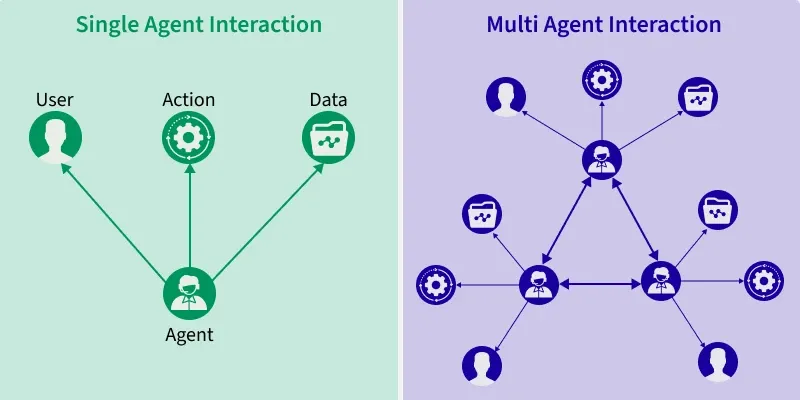
Enterprises are deploying multi-agent AI systems where specialized agents collaborate to solve complex problems. Unlike monolithic AI attempting everything, multi-agent systems assign specialized agents to specific tasks—one agent handles research, another analyzes data, a third generates reports, and a coordinator orchestrates their collaboration
What Are Multi-Agent Systems?
Collaborative AI: Multiple specialized agents working together—each agent has specific expertise and tools, agents communicate and coordinate, they divide complex tasks, combine results, and learn from collective experience.
Swarm Intelligence: Emergent capabilities from simple agents—individual agents follow simple rules, complex behaviors emerge from interactions, the system adapts without central control, and collective intelligence exceeds individual agent capabilities.
Enterprise Applications: Multi-agent systems handle complex workflows—customer service with specialized agents, business process automation, research and analysis, supply chain optimization, and collaborative decision-making.
Multi-Agent Architecture Patterns
Hierarchical Coordination: Supervisor agent assigns tasks to worker agents, monitors progress, handles escalations, and assembles final results. Workers specialize in specific functions and report back to supervisor.
Peer-to-Peer Collaboration: Agents interact directly without central coordinator—each agent broadcasts needs, others respond with relevant capabilities, collaboration emerges organically, and consensus forms through discussion.
Market-Based Systems: Agents bid for tasks based on capabilities and availability, with task allocation through auction mechanisms, dynamic pricing based on demand, and load balancing through market forces.
Blackboard Architecture: Shared knowledge space where agents post information, read others' contributions, build collectively on shared knowledge, and solve problems collaboratively.
Enterprise Use Cases
Customer Service Swarms: Specialized agents handle different aspects—intent classification agent routes inquiries, knowledge retrieval agent finds relevant information, response generation agent creates answers, escalation agent determines when humans needed, and learning agent improves from interactions.
Business Intelligence: Collaborative analysis with data extraction agents pulling from sources, cleaning agents preprocessing data, analysis agents running calculations, visualization agents creating charts, and narrative agents explaining insights.
Supply Chain Optimization: Coordinated planning through demand forecasting agents, inventory optimization agents, logistics planning agents, supplier coordination agents, and risk monitoring agents.
Software Development: Development swarms with coding agents implementing features, testing agents validating functionality, documentation agents creating docs, review agents checking quality, and deployment agents managing releases.
Technical Implementation
Agent Communication: Structured messaging between agents using message queues, APIs, shared databases, and event streams. Protocols define message formats, conversation patterns, and coordination mechanisms.
Task Allocation: Distributing work effectively through capability matching, load balancing, priority handling, and dynamic reassignment based on agent availability and expertise.
Conflict Resolution: Handling disagreements when agents propose different solutions through voting mechanisms, authority hierarchies, cost-benefit analysis, and human arbitration for critical decisions.
State Management: Maintaining coherent system state across distributed agents with shared knowledge bases, eventual consistency, transaction coordination, and rollback capabilities.
How EdJAMON Trains Multi-Agent System Developers
Multi-Agent Fundamentals: Students learn agent architecture patterns, communication protocols, coordination mechanisms, swarm intelligence principles, and when multi-agent approaches excel.
Building Agent Systems: Real projects create multi-agent applications—customer service swarms, business intelligence systems, supply chain optimization, and collaborative coding platforms. Students implement agent communication, task allocation, and coordination.
Agent Communication: Training in message passing, event-driven coordination, shared state management, and conflict resolution. Students implement robust communication layers.
Frameworks and Tools: Experience with AutoGPT, CrewAI, LangGraph, Microsoft Semantic Kernel, and custom implementations. Students compare framework capabilities.
Testing and Debugging: Techniques for multi-agent systems—unit testing individual agents, integration testing coordination, simulation environments, visualization tools, and debugging distributed behavior.
Conclusion
Multi-agent systems and swarm intelligence enable enterprises to tackle complex problems through collaborative AI. Specialized agents working together achieve capabilities impossible for single models. EdJAMON prepares professionals through comprehensive training in multi-agent architectures, coordination mechanisms, and practical implementation.
Topics & Tags
MultiAgentSystemsSwarmIntelligenceEnterpriseAIAIAgentsAutonomousAI