Article Content
Introduction
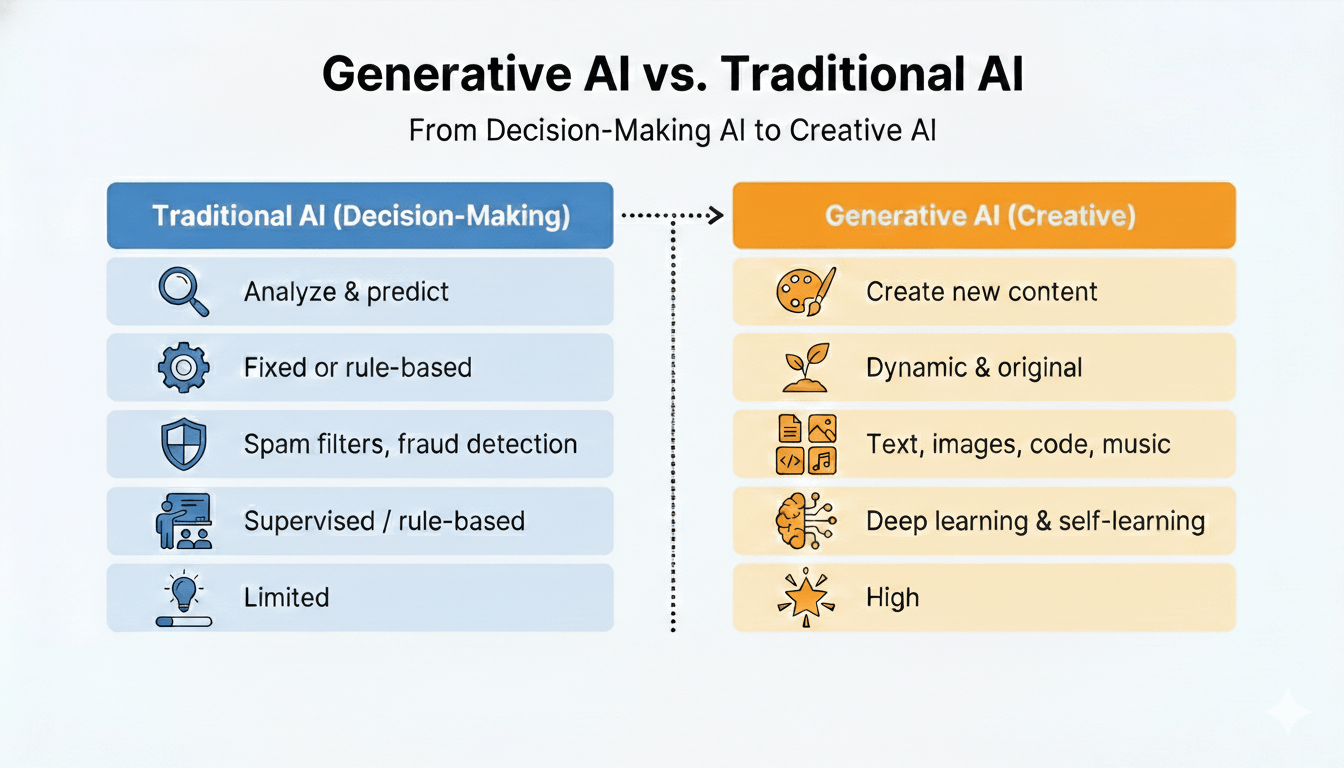
The AI landscape has split into two distinct paradigms, and developers need to understand both. Traditional AI has powered recommendation engines, fraud detection, and predictive analytics for years. But Generative AI—the technology behind ChatGPT, Midjourney, and GitHub Copilot—represents a fundamental shift in what AI can create.
What Is Traditional AI?
Traditional AI, also called discriminative AI, focuses on analyzing data and making predictions or decisions.Key characteristics include: Classifies and categorizes existing data. Makes predictions based on learned patterns. Optimizes decisions through established rules. Requires structured, labeled training data. Produces deterministic, consistent outputs.
Common applications span: Spam detection in email systems. Credit scoring and loan approval. Medical diagnosis and treatment recommendations. Recommendation engines for Netflix and Amazon. Fraud detection in banking transactions. Predictive maintenance in manufacturing equipment.
What Is Generative AI?
Generative AI creates new content—text, images, code, music, or video—that didn't exist before.
Key characteristics include: Generates novel content from prompts. Learns patterns from massive datasets. Produces creative, varied outputs. Works with unstructured data. Can surprise with unexpected solutions.
Common applications span: Code generation through GitHub Copilot. Content creation via ChatGPT and Claude. Image generation using DALL-E and Midjourney. Music composition with AIVA. Video synthesis through Runway ML. Synthetic data generation for training other AI models.
Technical Differences That Matter
Model Architecture: Traditional AI uses decision trees, random forests, support vector machines, and convolutional neural networks for classification. Generative AI employs transformers, generative adversarial networks, variational autoencoders, and diffusion models.
Training Approach: Traditional AI relies on supervised learning with carefully labeled datasets. Generative AI uses self-supervised learning on vast text, image, or audio corpora without explicit labels.
Output Type: Traditional AI produces labels, scores, categories, and predictions. Generative AI creates new text, images, code, audio, and video content.
Computational Resources: Traditional AI can run on modest hardware. Generative AI requires significant compute power with GPUs or TPUs.
How EdJAMON Training Platform Teaches Both Paradigms
EdJAMON's curriculum recognizes that modern developers need expertise in both AI approaches.
Traditional AI Training: Students build classification and regression models from scratch using scikit-learn. A project example includes predicting customer churn for an e-commerce platform using historical purchase data, demographic information, and browsing patterns. Students implement logistic regression, random forests, and gradient boosting, then compare results.
Feature Engineering Practice: Learners master the art of extracting meaningful features from raw data. Projects include transforming transactional data into predictive features, creating time-based aggregations, and engineering domain-specific indicators that improve model accuracy.
Model Deployment: Students deploy traditional ML models to production environments. A capstone involves building a fraud detection system that processes real-time transactions, flags suspicious activity, and integrates with existing payment infrastructure.
Generative AI Training: Students work with GPT, Claude, and open-source alternatives like Llama. Projects include building a customer service chatbot that handles inquiries, generates personalized responses, and escalates complex issues to humans.
Prompt Engineering Mastery: Learners develop expertise in effective AI communication. Training covers zero-shot, few-shot, and chain-of-thought prompting techniques. A practical exercise involves optimizing prompts to generate production-ready code with minimal manual editing.
Fine-Tuning Models: Students customize models for specific use cases. A project involves fine-tuning a code generation model on company-specific coding standards and architectural patterns, creating an AI assistant that matches organizational conventions.
API Integration: Students build applications using OpenAI, Anthropic, and Hugging Face APIs. Projects include creating content generation platforms, automated documentation systems, and AI-powered developer tools.
Skills Needed for Each
Traditional AI developers require: Statistics and probability foundations. Data preprocessing and cleaning expertise. Feature engineering creativity. Model evaluation and selection knowledge. Python proficiency with NumPy, Pandas, and scikit-learn.
Generative AI developers require: Prompt engineering expertise. API integration skills. Understanding of transformer architecture. Fine-tuning techniques knowledge. Python proficiency with Transformers, LangChain, and OpenAI SDK.
Conclusion
The future belongs to developers who understand both Traditional and Generative AI, knowing when to apply each. EdJAMON's holistic training approach ensures you're not just an AI developer, but a strategic AI problem-solver ready to build the next generation of intelligent applications. Master both paradigms and position yourself as an invaluable asset in the AI-driven technology landscape.
Topics & Tags
GenerativeAITraditionalAIMachineLearningTransformersPromptEngineeringFeatureEngineeringModelDeployment
