Article Content
Introduction
AI and blockchain are converging in fascinating ways. Blockchain's decentralization meets AI's intelligence, creating new possibilities for model ownership, training transparency, data marketplaces, and AI governance. While much remains experimental, decentralized AI promises solutions to centralization concerns
Why Combine AI and Blockchain?
Decentralized Model Ownership: Current AI concentrates in few companies controlling models, data, and infrastructure. Blockchain enables collective ownership through tokenized model rights, distributed training contributions, transparent governance, and shared economic benefits.
Training Data Marketplaces: Blockchain facilitates data exchange with verifiable data provenance, fair compensation for contributors, privacy-preserving transactions, and transparent attribution tracking data usage.
Transparent Model Development: Blockchain provides immutable audit trails—recording training procedures, documenting data sources, tracking model versions, and enabling reproducibility verification.
Decentralized Inference: Distributing AI computation across networks reduces centralized control, improves availability, enables censorship resistance, and creates new economic models.
Key Applications
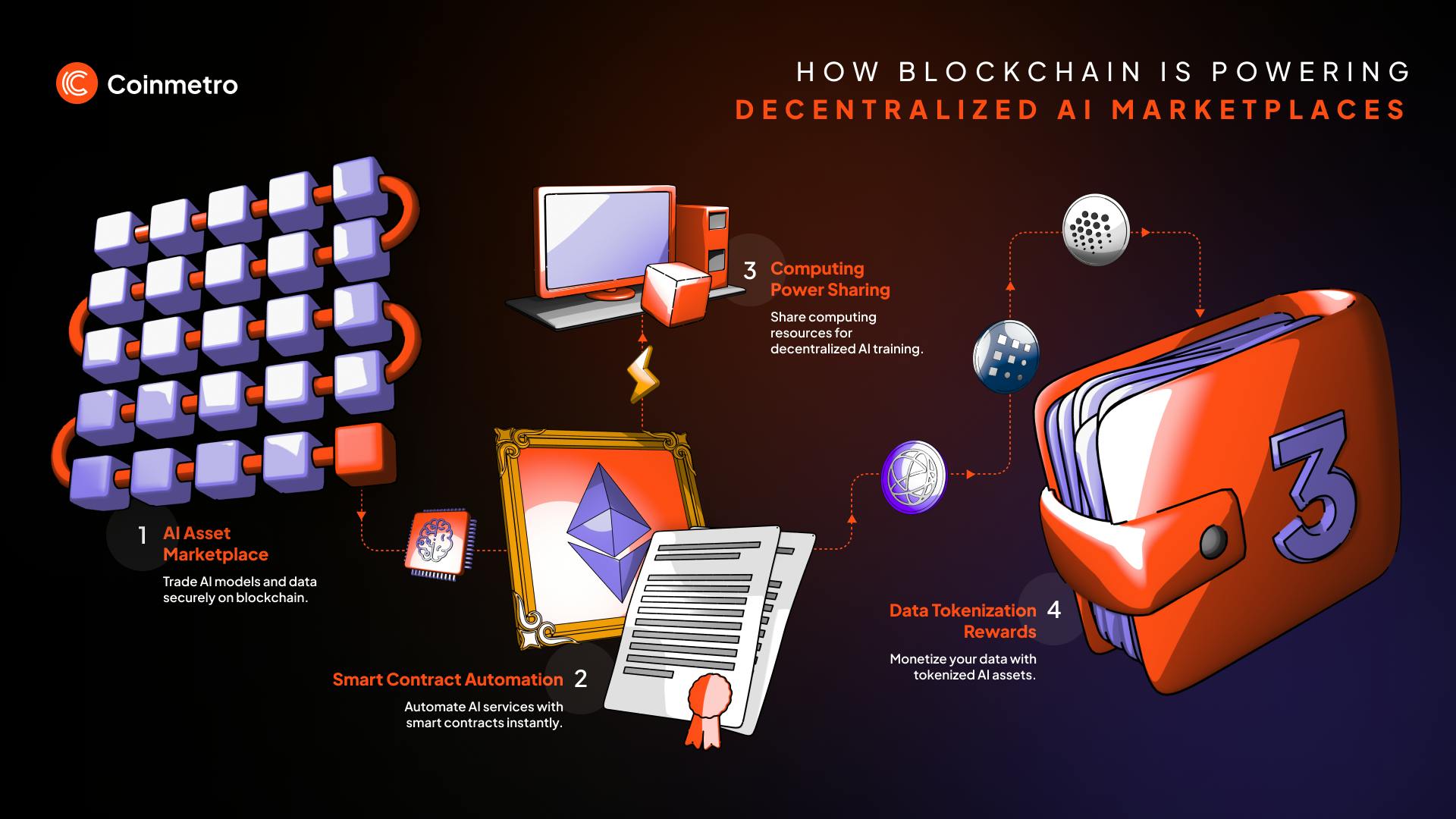
Decentralized Training: Networks of participants collaboratively train models—contributing compute resources, sharing private data via federated learning, receiving crypto rewards, and collectively owning resulting models. Projects like Bittensor implement this vision.
AI Data NFTs: Blockchain-based data ownership where datasets become tradeable NFTs, creators receive royalties on use, provenance tracks data lineage, and smart contracts enforce usage terms.
Model Marketplaces: Decentralized platforms for AI model exchange—developers publish models as NFTs, users purchase or license access, blockchain ensures attribution, and smart contracts handle payments.
Verifiable AI: Blockchain proves AI authenticity—cryptographic proof of model origin, verification of training procedures, detection of tampering, and authentication of AI-generated content.
Decentralized AI Governance: Community-governed AI development through token-based voting on model changes, transparent decision-making, aligned incentives, and democratic AI direction.
Technical Architecture
On-Chain Components: Blockchain handles ownership records and NFTs, smart contracts for transactions and governance, token economics for incentives, and identity and reputation systems.
Off-Chain Components: Actual AI training and inference happen off-chain due to computational requirements, storage constraints, and cost considerations. Blockchain provides coordination and verification.
Hybrid Approaches: Combining strengths of both—blockchain for coordination and ownership, traditional infrastructure for computation, cryptographic proofs linking the two, and optimistic execution with fraud proofs.
Challenges and Limitations
Scalability: Blockchain transactions are slow and expensive. Recording every training step or inference is impractical. Solutions include batch proofs, layer-2 protocols, and selective on-chain recording.
Centralization Risks: Decentralized AI may centralize differently—wealthy participants dominating governance, compute requirements favoring large players, and expertise barriers limiting participation. True decentralization requires careful design.
Quality Control: Decentralized systems struggle with quality—no central authority ensuring model safety, difficulty removing harmful models, coordinating upgrades, and maintaining standards.
Regulatory Uncertainty: Regulators struggle categorizing decentralized AI—who's liable for outputs, how to enforce compliance, taxing crypto rewards, and applying AI regulations to DAOs.
User Experience: Blockchain complexity creates friction—wallet management, gas fees, transaction delays, and technical barriers limiting mainstream adoption.
Emerging Projects and Platforms
Bittensor: Decentralized machine learning network where miners produce intelligence, validators assess quality, TAO tokens reward contributors, and the network collectively owns models.
Ocean Protocol: Data marketplace enabling data tokenization, privacy-preserving exchange, fair compensation, and transparent usage tracking.
Fetch.ai: Autonomous economic agents using blockchain for coordination, decentralized machine learning, agent-based commerce, and smart infrastructure.
SingularityNET: Decentralized AI marketplace where developers publish AI services, users access via AGI tokens, transparent pricing, and community governance.
How EdJAMON Trains Decentralized AI Specialists
Blockchain Fundamentals: Students learn blockchain basics, smart contracts, tokenomics, decentralized systems, and consensus mechanisms.
AI + Blockchain Integration: Training in combining technologies—designing hybrid architectures, optimizing for blockchain constraints, implementing proof systems, and balancing decentralization with performance.
Smart Contract Development: Building AI-related contracts—model ownership NFTs, data marketplace logic, training reward distribution, and governance mechanisms.
Decentralized Training: Implementing federated learning with blockchain coordination, incentive structures, contribution verification, and result aggregation.
Economic Design: Creating sustainable tokenomics—incentivizing quality contributions, preventing gaming, balancing supply and demand, and aligning stakeholder interests.
Real-World Projects: Building decentralized AI applications—data marketplaces, model sharing platforms, collaborative training networks, and verifiable inference services.
Conclusion
AI and blockchain convergence creates possibilities for decentralized model ownership, transparent development, and democratized access. While challenges remain, the vision of collectively owned, transparently governed AI offers alternative to centralized control. EdJAMON prepares professionals through comprehensive training in both domains and their integration.
Topics & Tags
AIBlockchainDecentralizedAIModelOwnershipWeb3SmartContractsAIGovernance

